gracezhang@yijiecool.com |
  English
 Español
 عربى
عربى


Scroll Compressor Guide: Working Principle, Benefits, Limitations, and System Matching
Content
A scroll compressor is a positive-displacement machine that compresses refrigerant or air with two interleaved spiral scrolls instead of a piston. One scroll stays fixed; the other orbits around it and pushes gas from the outer edge to a center discharge port. It is the quiet, efficient workhorse behind most residential air conditioners, heat pumps, and light commercial refrigeration up to about 30 tons of capacity.
That reputation is earned through design. Scroll compressors run smoother, vibrate less, and avoid the valve losses that limit piston machines. But the compressor never works alone. Its rated efficiency shows up only when the condenser and evaporator coils move heat at the flow the compressor expects. As a custom heat exchanger manufacturer, we see the scroll compressor as the component that makes coil design the real difference between a good system and a great one.
How a scroll compressor works
Picture two identical spirals nested together, one flipped over. The upper spiral is fixed; the lower spiral rides on an offset shaft and moves in a small circle without rotating. The crescent-shaped spaces between the two scrolls travel inward while shrinking, which creates continuous compression.
- Suction. Low-pressure vapor enters around the outer openings of the scroll set.
- Trapping. The orbiting scroll seals one or more crescent-shaped pockets along the spiral wall.
- Compression. The pockets move toward the center while their volume constantly decreases.
- Discharge. High-pressure gas leaves through the port at the center of the fixed scroll.
The construction is simple in moving parts: a fixed scroll, an orbiting scroll, an anti-rotation coupling, a drive shaft, and a sealed shell. Removing the suction and discharge valves that piston compressors need removes a common failure point at the same time. The smooth, near-pulseless flow also lets engineers skip the heavy discharge mufflers that piston designs require.
Advantages and limitations
Efficiency, quietness, and reliability
The efficiency gain comes mainly from eliminating valve losses and dead volume. A scroll compressor pushes virtually every ounce of refrigerant that enters the scrolls out through the discharge port, with nothing left to re-expand on the next stroke. Against a well-built piston compressor, the practical benefit is about two to three percent at full load and noticeably more at part load.
The orbiting motion also smooths torque. There is no piston reversing direction twice per revolution, so vibration stays low and the machine can be installed close to occupied spaces without disturbing anyone.
Costs and limits to keep in mind
The trade-off is the price of precision. Machining the scroll members to the required tolerances costs more than casting a cylinder, and the failure mode is usually replacement rather than repair. A contaminated charge or repeated liquid slugging can ruin the scroll set; at that point, labor plus the replacement kit often approaches the cost of a new compressor.
Capacity is another boundary. Single scroll compressors usually top out around 20 to 30 tons. Larger plants stage several scroll modules in parallel or switch to a screw compressor instead.
| Characteristic | Scroll | Reciprocating | Rotary |
|---|---|---|---|
| Compression motion | Orbiting spiral | Linear piston stroke | Eccentric roller |
| Discharge flow | Near continuous | Pulsing | Moderate pulse |
| Valve losses | Minimal | Suction and discharge valves | Discharge valve only |
| Noise and vibration | Low | Higher | Low to moderate |
| Typical capacity range | Up to roughly 30 tons | Fractional to 50+ tons | Usually under 3 tons |
| Installation cost | Higher | Lower | Low |
| Service approach | Replacement dominated | Rebuildable parts | Usually replaces the unit |
Common applications
Scroll compressors now appear wherever efficiency and noise must be balanced. The most common placements are:
- Residential air conditioning and heat pumps.
- Cold storage and light commercial refrigeration, including freezer rooms.
- Automotive air conditioning, with strong growth in electric vehicles because scroll units tolerate wide speed swings quietly.
- Oil-free compressed air for medical, dental, and food processing.
- Modular chiller plants that stage multiple scroll compressors for part-load efficiency.
In a household heat pump, the seasonal efficiency that customers actually measure is the sum of compressor efficiency plus coil design. The compressor may carry the rated COP, but a household air-source heat pump heat exchanger matched to the condenser keeps that advantage from leaking away in cold weather.
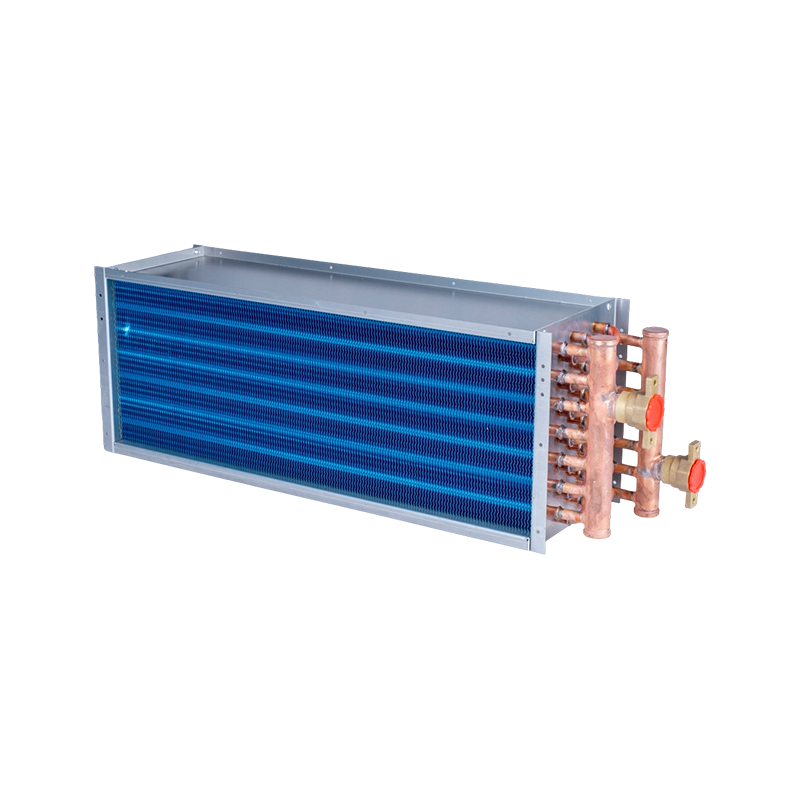 Household Air Source Heat Pump Coil Manufacturers, Custom Factory - Hangzhou YijAs Custom Household Air Source Heat Pump Coil Manufacturers and Household Air Source Heat Pump Coil Factory in China, Yijie supply Househ...View Product →
Automotive systems push the balance even harder. The condenser must reject heat into air already warmed by the engine radiator, which shrinks the available temperature difference. Tube geometry and fin density have to do more work, so an aluminum tube automotive condenser often decides whether the cabin reaches its target temperature in heavy traffic. For maintenance teams, our automotive heat exchanger types and maintenance guide covers the failure patterns most often found in service.
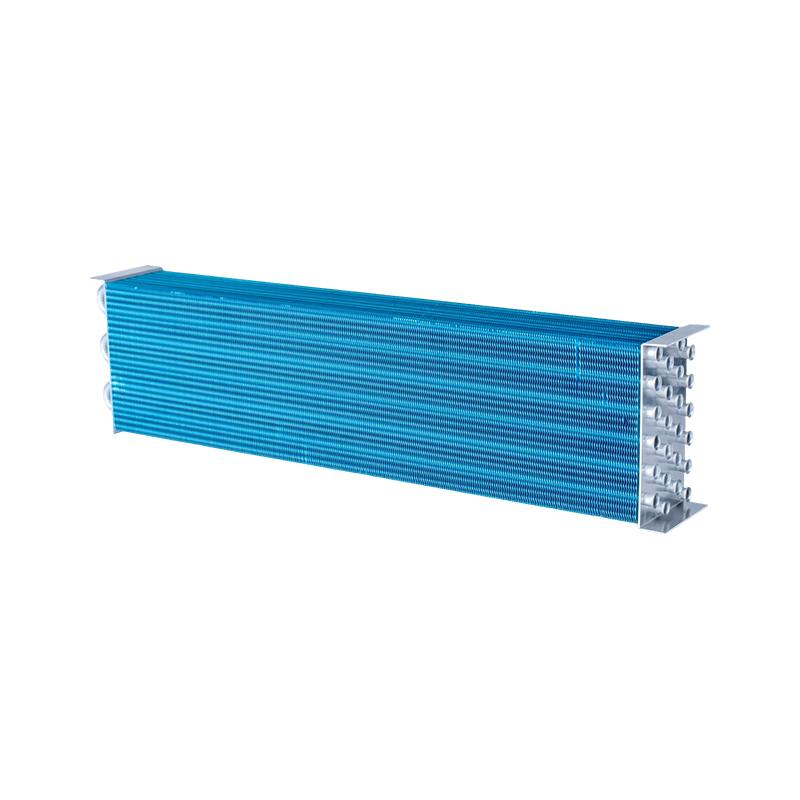 Aluminum-Tube Automotive Condenser Manufacturers, Custom Factory - Hangzhou YijiAs Custom Aluminum-Tube Automotive Condenser Manufacturers and Aluminum-Tube Automotive Condenser Factory in China, Yijie supply Aluminum...View Product →
Refrigeration rooms create a different stress: scroll compressors run long hours at high discharge temperatures, so the condenser has to reject extra heat without raising head pressure. A freezer condenser built for low-ambient operation keeps the cycle stable in exactly the conditions where scroll performance can degrade fastest.
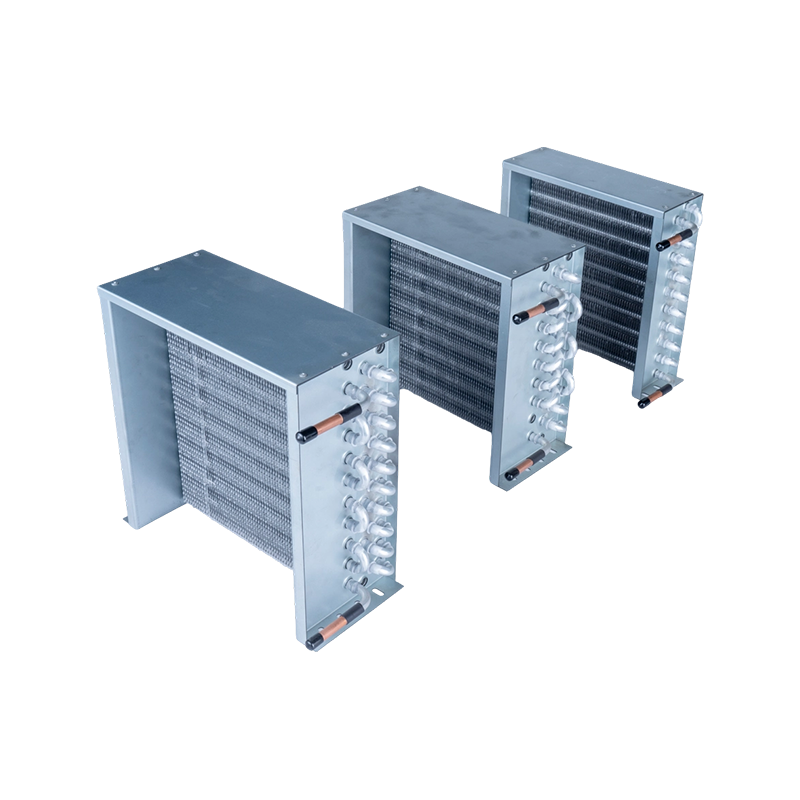 Aluminum Tube Freezer Condenser Manufacturers, Custom Factory - Hangzhou Yijie RAs Custom Aluminum Tube Freezer Condenser Manufacturers and Aluminum Tube Freezer Condenser Factory in China, Yijie supply Freezer Conden...View Product →
Why heat exchanger matching decides real-world performance
Think of the compressor as the heart of a refrigeration circuit and the coils as the lungs. The scroll raises the pressure and sets the mass flow, while the evaporator and condenser decide how close the actual cycle comes to the theoretical one. An oversized condenser lowers head pressure but adds refrigerant charge and cost. An undersized evaporator starves the compressor, causing low suction pressure and frequent cycling. Both conditions shorten compressor life even though the compressor is usually the most expensive component in the loop.
Basic control values matter too. Leaving gas from the evaporator needs enough superheat to cool the scroll's internal motor, and the condenser must produce enough subcooling to prevent flash gas at the expansion valve. Change one component and the whole balance moves, which is why our HVAC heat exchanger guide starts with system-level questions before it touches coil geometry.
Material selection has shifted that balance in the past decade. Copper coils still dominate fixed residential systems, but aluminum is taking over outdoor and mobile duty for weight, cost, and corrosion reasons. A properly engineered aluminum tube dual-phase heat exchanger can cut material cost by more than 30 percent while still passing 500-hour salt spray and 50,000-cycle pressure endurance tests. It is not a simple dimension swap, though: joint design, fin stock, and refrigerant compatibility all have to be validated for the compressor's operating range. That is the core job of an aluminum tube dual-phase heat exchanger manufacturer.
What to check when you specify or replace a scroll compressor system
Whether you are designing a new product line or replacing a failed outdoor unit, the same checklist applies:
- Confirm the operating envelope with the compressor supplier, including evaporating temperature, condensing temperature, and refrigerant.
- Compare part-load efficiency; an inverter or digital scroll can cut energy use sharply when the system rarely runs at full capacity.
- Check liquid tolerance. Scrolls survive small slugs better than pistons, but no compressor survives repeated flooding.
- Size the evaporator, condenser, and expansion device from the compressor's rated mass flow, not from the room load alone.
- Ask for durability evidence on the coils: salt spray hours, pressure cycle counts, and leak test criteria.
- Calculate lifetime cost, including the replacement-based service model of scroll compressors, before quoting a contract.
The practical takeaway is to design in circuits, not components. A scroll compressor delivers smooth compression; the coils, refrigerant control, and piping complete the circuit and create the customer experience. When you source a condenser or evaporator, bring the compressor model and operating conditions into the conversation. That is the information an OEM heat exchanger factory needs to optimize the coil for your specific output instead of delivering a generic catalog part.