gracezhang@yijiecool.com |
  English
 Español
 عربى
عربى


Components of an Air Conditioning System: Function, Failure Signs and Buying Tips
Content
A maintenance technician stops in front of a rooftop unit that is blowing warm air on a hot afternoon. The filter is clean, the thermostat is correctly set, and both fans are running. The problem is almost certainly inside the sealed refrigerant loop.
That loop, repeated in nearly every air conditioning system on the market, contains exactly four essential components: the compressor, the condenser coil, the expansion valve, and the evaporator coil. Everything else, including the thermostat, blower, refrigerant, and ductwork, exists either to support these four parts or to move the conditioned air where it needs to go.
The Four Main Components of an Air Conditioning System
Every air conditioning system, from a window unit to a rooftop packaged unit, relies on the same vapor-compression cycle. The table below summarizes each component's function and common failure signs.
| Component | Function | Location | Typical Warning Sign |
|---|---|---|---|
| Compressor | Raises refrigerant pressure and drives refrigerant through the loop | Outdoor unit | Loud operation, short cycling |
| Condenser Coil | Releases heat from compressed refrigerant to outdoor air | Outdoor unit, next to the compressor | Poor cooling, high head pressure |
| Expansion Valve | Drops refrigerant pressure and temperature before the evaporator | Indoor section of the refrigerant line | Frost on the suction line |
| Evaporator Coil | Absorbs heat from indoor air and removes humidity | Indoor air handler | Ice buildup, weak cooling |
The Compressor
The compressor is the pump of the system and the only component that performs mechanical work on the refrigerant. It draws low-pressure gas from the evaporator, compresses it, and pushes it toward the condenser as a high-temperature, high-pressure gas. Because it runs whenever the system calls for cooling, it wears fastest when the refrigerant charge is wrong or the airflow across the condenser is poor. Modern equipment increasingly uses scroll compressors instead of reciprocating types because scrolls tolerate liquid refrigerant better and operate more quietly.
The Condenser Coil
Once refrigerant leaves the compressor, it enters the condenser coil as a hot gas. The outdoor fan pulls air across the coil surface, removing heat and condensing the refrigerant into a liquid. The condenser has a simple objective: reject as much heat as possible to keep the condensing pressure low. A dirty or restricted coil raises head pressure, increases energy consumption, and accelerates compressor wear.
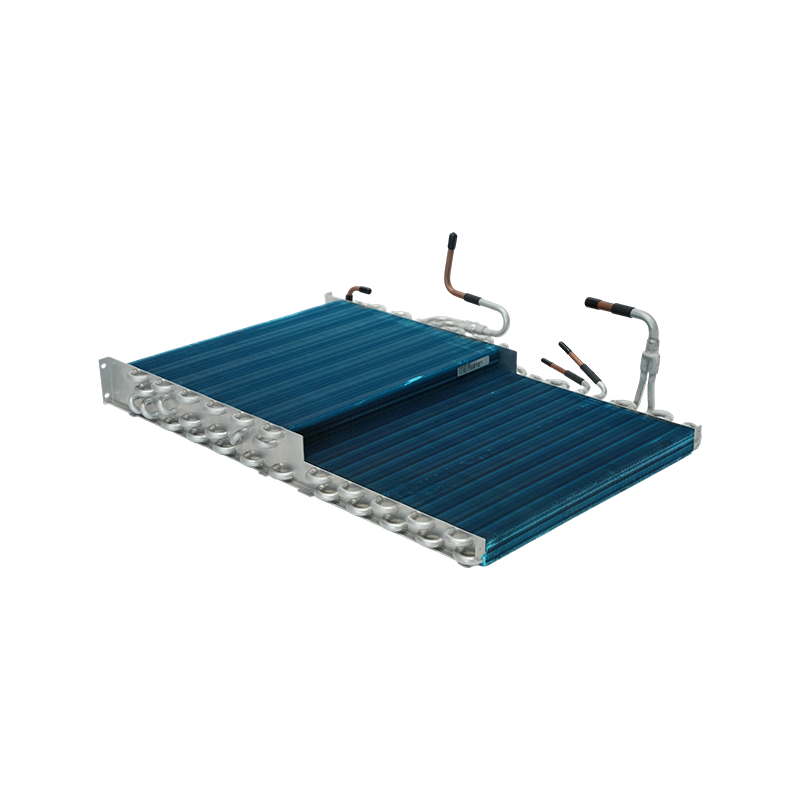
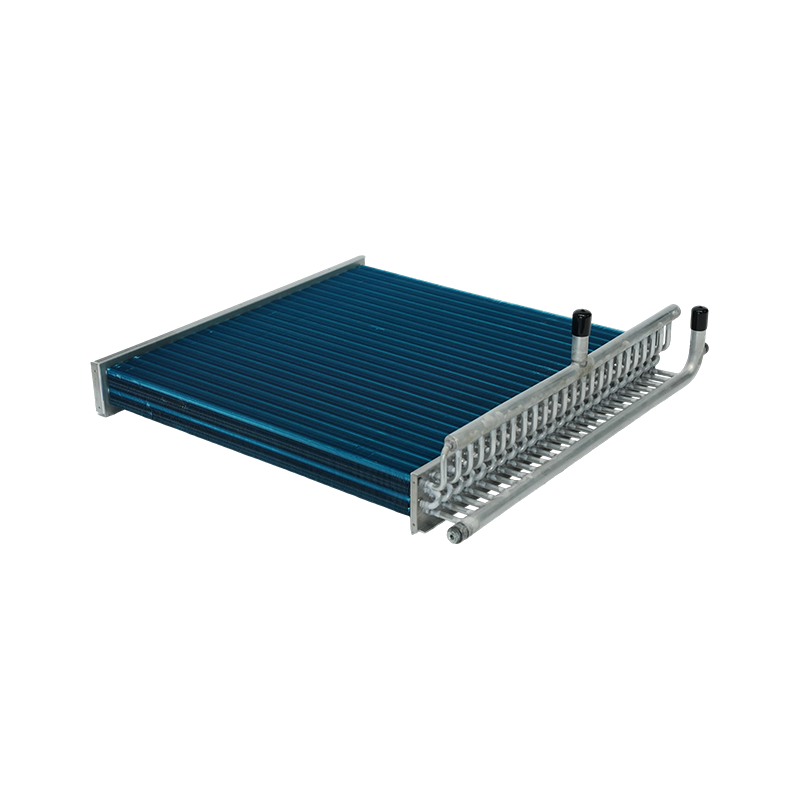
Material selection matters more than most spec sheets suggest. Copper tubes with aluminum fins are the traditional choice, but all-aluminum coils are increasingly used in outdoor and portable equipment because aluminum handles corrosion more predictably and costs less per unit of heat transfer. For an OEM evaluating condensing coils, the key parameters are coil rows, fin spacing, tube diameter, and corrosion protection.
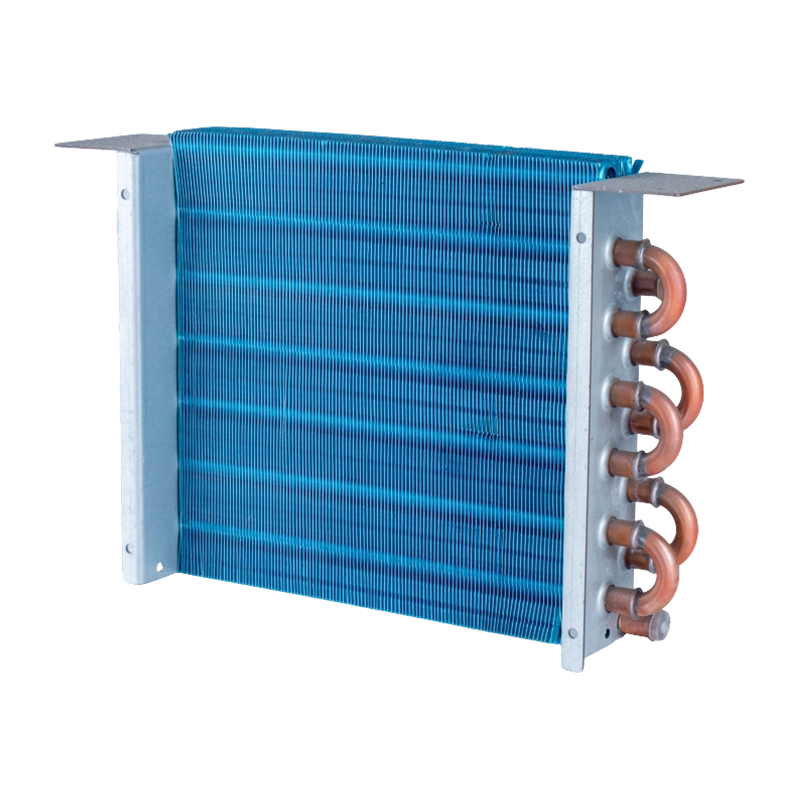
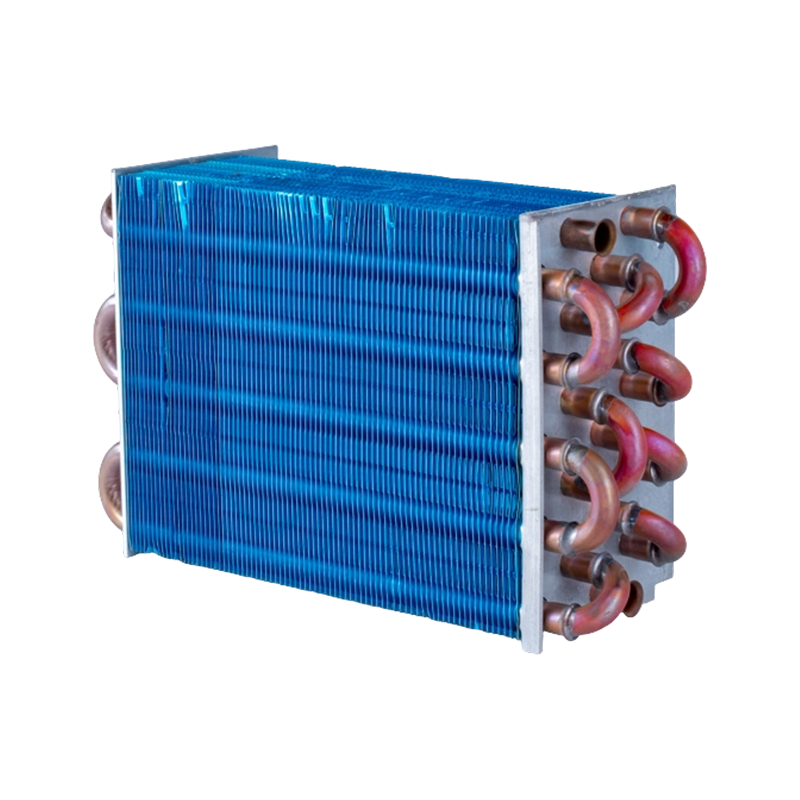 Compact Copper-Core Outdoor AC Condenser with Hydrophilic Louvered FinsThis outdoor condenser offers a compact 105 x 50.8 x 127 mm core with hydrophilic louvered fins for efficient drainage and heat transfer. Its copper construction and galvanized steel housing suit residential and light commercial AC systems.View Product →
The Expansion Valve
The expansion valve is a small metering device located between the condenser and the evaporator. It creates a sudden pressure drop, which allows the refrigerant to evaporate at the low temperature required for cooling. Traditional thermostatic valves use a temperature-sensitive bulb to modulate flow and maintain superheat; newer electronic expansion valves use a stepper motor and controller for finer control. A faulty valve normally appears as either a starved evaporator with frost on the lines or a flooded evaporator that returns liquid refrigerant to the compressor.
The Evaporator Coil
The evaporator coil is where actual cooling happens. Low-pressure liquid refrigerant enters the coil and boils by absorbing heat from the air passing over it. Because the coil surface operates below the dew point, it also removes moisture from the air, which drains away as condensation. This is why a correctly functioning air conditioner dehumidifies as it cools.
Evaporator design involves real trade-offs. More coil surface increases heat transfer and moisture removal, but it also raises air pressure drop and cabinet size. Fin density, tube geometry, and refrigerant distribution must be matched to the compressor and expansion device. A coil that performs well in one system can deliver poor results in another if mismatched, which is why custom sizing and OEM-level validation matter.
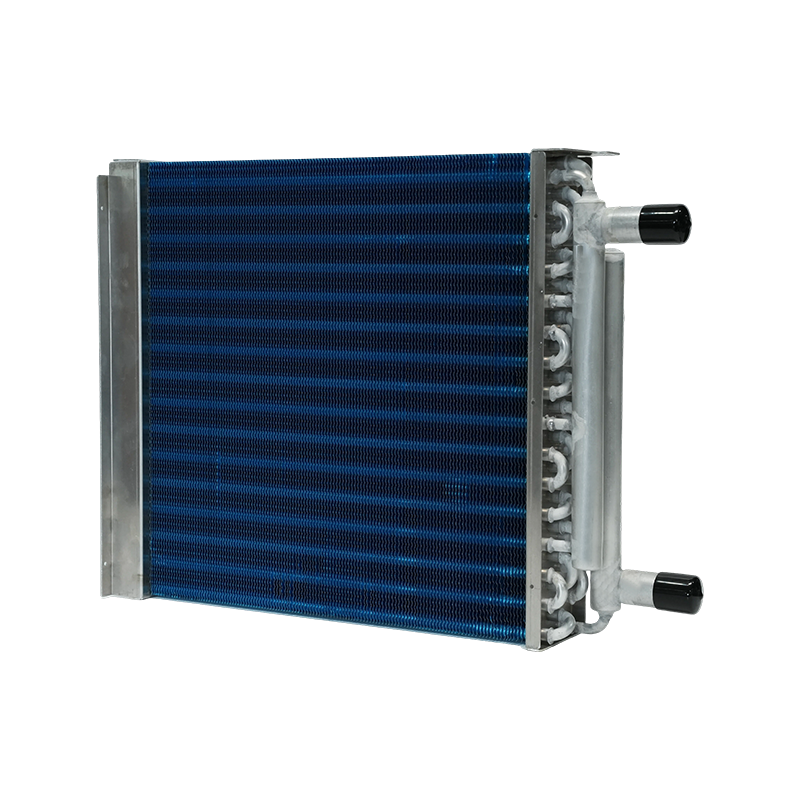
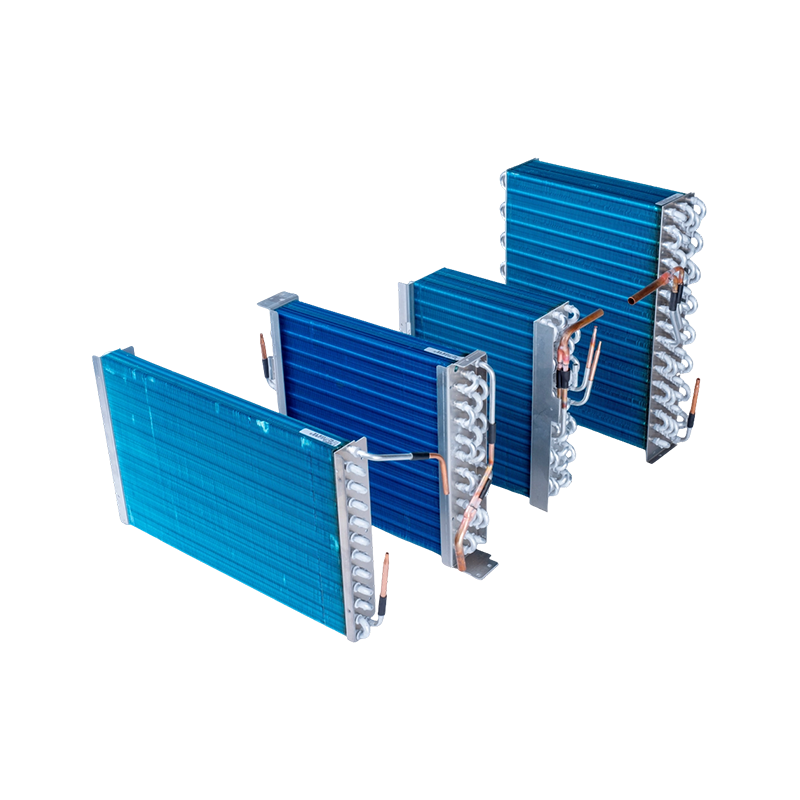 Household Evaporator with Hydrophilic Aluminum Fins and Copper TubingDesigned for residential AC, this evaporator features a 294 x 50.8 x 400 mm core, hydrophilic aluminum fins, and copper tubes for reliable cooling. The all-aluminum housing keeps it lightweight and corrosion-resistant.View Product →
Supporting Components That Affect Performance
The four main components handle the refrigeration cycle, but several supporting parts determine whether that cycle runs efficiently.
Thermostat
The thermostat senses indoor temperature and cycles the compressor and blower. A smart thermostat adds scheduling and remote control, but its core role remains: it starts and stops the cooling cycle.
Air Handler and Blower
The blower moves conditioned air across both coils and through the ductwork. Low airflow can freeze the evaporator, while excessive airflow can push air past the coil before it transfers heat. Most residential systems operate best between 350 and 450 CFM per ton of rated capacity.
Refrigerant
Refrigerant is the working fluid that carries heat from indoors to outdoors. An undercharged system lowers evaporating pressure and causes icing; an overcharged system raises condensing pressure and draws excessive current. Checking the charge requires superheat and subcooling measurements, not just a pressure gauge.
Ductwork and Filters
Ductwork distributes the cooled air and brings return air back to the unit. Leaks in the return side pull in warm, dusty air that increases load and shortens filter life. Filters exist to protect the evaporator coil, so a clogged filter reduces airflow, lowers coil temperature, and eventually freezes the coil.
How the Components Work Together in a Cooling Cycle
Putting the loop in order makes fault isolation faster. A standard cooling cycle follows these steps:
- The compressor discharges hot, high-pressure refrigerant gas.
- The gas flows through the condenser coil, where outdoor air cools it into a high-pressure liquid.
- The liquid passes through the expansion valve, which drops its pressure and temperature.
- The cold, low-pressure mixture enters the evaporator coil, absorbs heat from indoor air, and boils back into a gas.
- The blower pushes the cooled air into the space, and the compressor draws the low-pressure gas back in to repeat the cycle.
When a customer reports weak cooling, trace the process in this order: confirm the compressor is running, check the condenser fan and coil, verify the expansion valve holds proper superheat, and inspect the evaporator for airflow and frost. Most field issues are resolved at one of these four points.
What to Look for When Sourcing AC Components
For OEM buyers and engineers, the same four components need evaluation before a design is locked. A spec sheet does not tell the whole story, so focus on these criteria:
- Corrosion resistance: for outdoor coils, request salt spray test data. A coil rated at 500 hours of neutral salt spray lasts much longer than one rated at 72 hours in coastal or industrial environments.
- Pressure cycling endurance: refrigeration loops experience stress changes every cycle. Components rated for 50,000 pressure cycles handle real-world fatigue far better than budget parts rated for only a few thousand cycles.
- Dimensional accuracy: in OEM production, a coil that is 2 mm out of spec creates sheet metal interference and mounting problems. Tolerance data should come from the supplier before parts arrive.
- System matching: the coil must fit the compressor displacement and the expansion valve flow range. A mismatch shows up as capacity loss, higher energy consumption, and short cycling.
These criteria are easier to evaluate when the supplier has documented experience. Hangzhou Yijie Refrigeration Technology, a custom heat exchanger supplier that has focused on aluminum-tube condensers and evaporators for more than a decade, works with OEM customers on coil geometry from the drawing stage and provides test reports before production begins.
For a closer look at how coil design affects efficiency and what maintenance keeps coils performing, the heat exchanger efficiency and maintenance guide is a useful next step.
An air conditioning system is not a mysterious machine. It is a refrigerant loop built around four well-understood components, supported by fans, controls, and airflow management. When performance drops, the cause is almost always in one of the four main parts or the airflow around them. When buying components for new equipment, apply the same logic: start with the compressor, then the condenser, expansion valve, and evaporator, and demand test data that supports reliability claims. That approach separates an air conditioner that costs little to run from one that becomes a repeating repair story.