gracezhang@yijiecool.com |
  English
 Español
 عربى
عربى


Chiller Design: Key Heat Exchanger Choices for Efficiency and Reliability
Content
When a chiller leaves the factory, its efficiency, reliability and operating cost have already been determined by a small set of design choices. The most consequential of those choices sit inside the refrigerant circuit: the evaporator, where heat is absorbed from the building water loop, and the condenser, where that heat is rejected. For anyone involved in chiller design or specification, the practical question is not simply which chiller brand to use, but how the heat exchangers are configured and whether the design supports the actual operating envelope.
The conclusion up front: chiller design success depends more on heat exchanger selection and material compatibility than on any single compressor or control algorithm. Get the evaporator and condenser right, and the rest of the system has a realistic path to good partial-load performance, long service life and maintainable operation.
Defining the Thermal Core of a Chiller
The evaporator and condenser are not generic components. Their design must match the refrigerant, the chilled water temperature range, the ambient or cooling-water condition, and the expected load profile. A chiller designed for a 6°C leaving chilled water temperature behaves differently from one designed for glycol at -15°C, even if both use the same compressor family.
Several parameters need to be fixed before any tube layout or fin density is selected:
| Parameter | Typical range | Design impact |
|---|---|---|
| Leaving chilled water temperature | 5 to 15°C for comfort cooling | Sets evaporating temperature and refrigerant side pressure |
| Condensing temperature | 35 to 55°C depending on climate | Determines compressor lift and condenser surface area |
| Approach temperature | 2 to 5 K for water-cooled systems | Directly relates to heat exchanger size and efficiency |
| Flow rate and pressure drop | Usually set by pump or fan selection | Influences tube count, circuiting and fouling margin |
| Fouling factor | 0.044 to 0.176 m2·K/kW | Accounts for water quality and maintenance interval |
Once these values are in place, the heat exchanger geometry and material can be selected with confidence.
Evaporator Design Considerations
The evaporator is where the chiller does its useful work. In a typical water-cooled chiller, refrigerant evaporates inside the tubes while water flows outside, or vice versa depending on the design family. The goal is to achieve a high heat transfer coefficient with a stable refrigerant film, without causing maldistribution in a multi-circuit arrangement.
Designers should pay attention to a few specific points:
- Use multiple refrigerant circuits when the capacity demands it, but design each circuit for an equal share of the thermal load.
- Select a tube diameter that balances water-side pressure drop against the need for a large wetted surface area.
- Check the minimum load condition. An evaporator that works at full load may suffer from poor refrigerant return at 20% load.
- For chilled water or glycol applications, confirm that the evaporator can be drained and cleaned without removing the entire refrigerant charge.
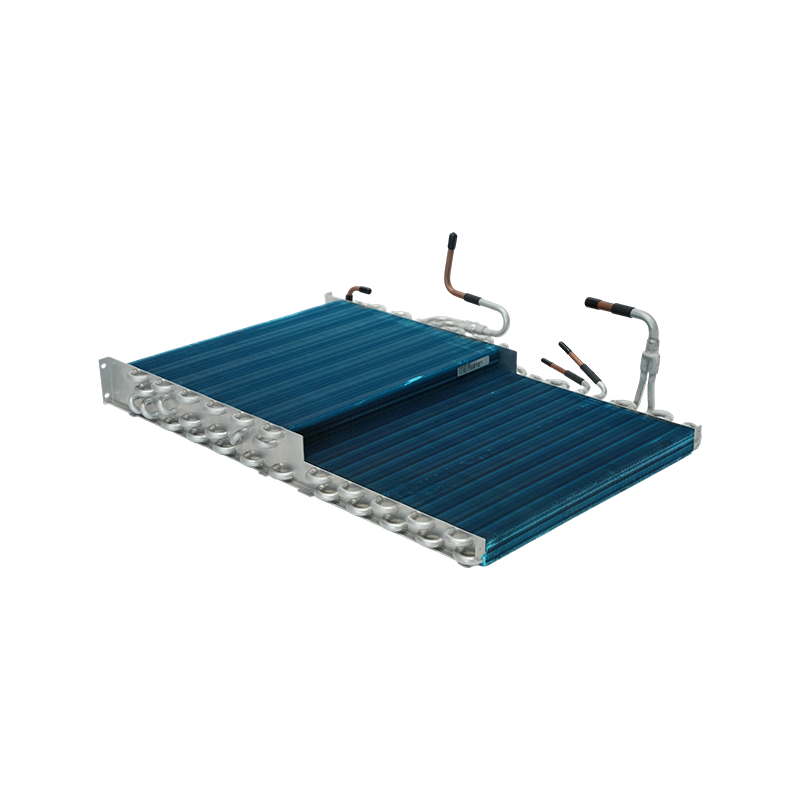
For larger chiller packages, a purpose-built commercial evaporator is usually a better route than adapting a small refrigeration coil. The tube count, distributor geometry and shell volume all need to match the compressor capacity map.
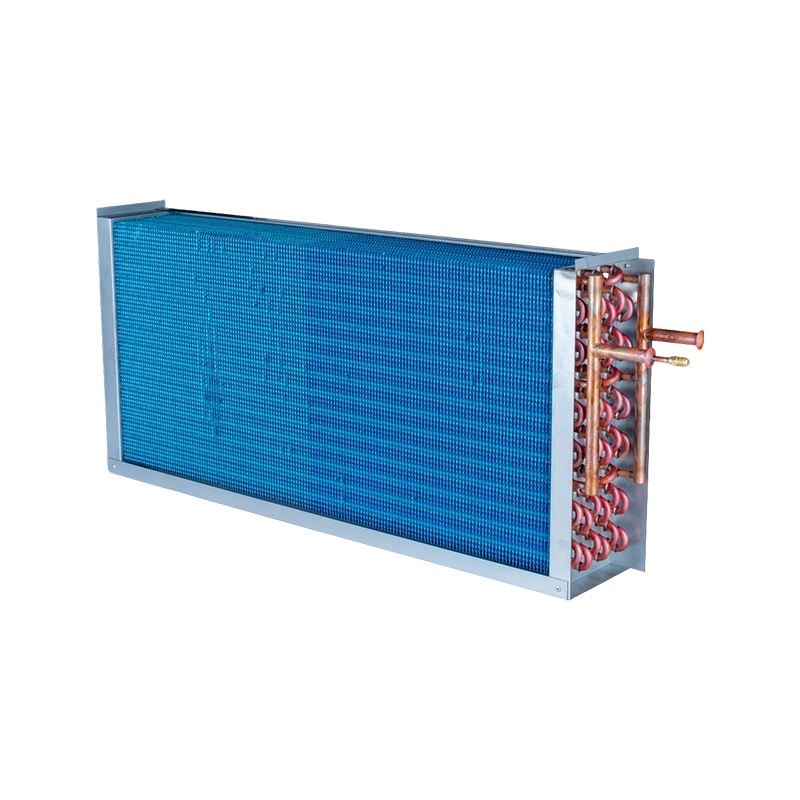 Large Commercial Evaporator for Chiller SystemsThis all-copper evaporator with hydrophilic aluminum fins suits commercial refrigeration. Its compact dimensions and efficient heat exchange support rapid cooling, making it a practical choice for larger chiller packages seeking reliable performance.View Product →
Condenser Design Considerations
The condenser must reject the heat absorbed by the evaporator plus the compressor work. This makes it the largest heat rejection component in the chiller, and often the easiest place to lose efficiency through poor design. A condenser that is undersized by 10% can raise condensing temperature enough to increase compressor power by a measurable margin over the life of the unit.
Water-cooled condensers use cooling tower water or a closed loop, while air-cooled condensers rely on ambient air. In either case, the design should include:
- Sufficient subcooling to prevent flash gas at the expansion valve.
- A clean refrigerant path with no oil trapping in horizontal return bends.
- Finned surfaces with the correct fin spacing for the cleanliness level of the installation site.
- Accessibility for coil cleaning, because dirt and scale will degrade performance faster than almost any other factor.
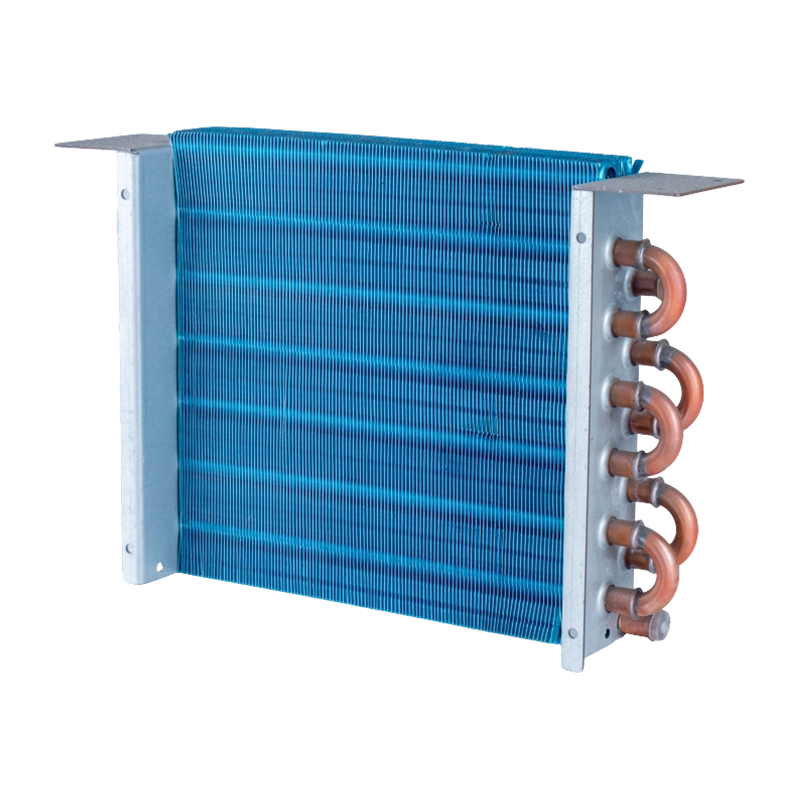
Do not specify a 2 K approach if the cooling tower can only deliver 3 K at peak design conditions. Compact condenser designs are particularly useful when the chiller is packaged into a modular plant room or a rooftop frame. Space is not just a layout issue; it affects airflow, service access and the ability to replace a damaged coil.
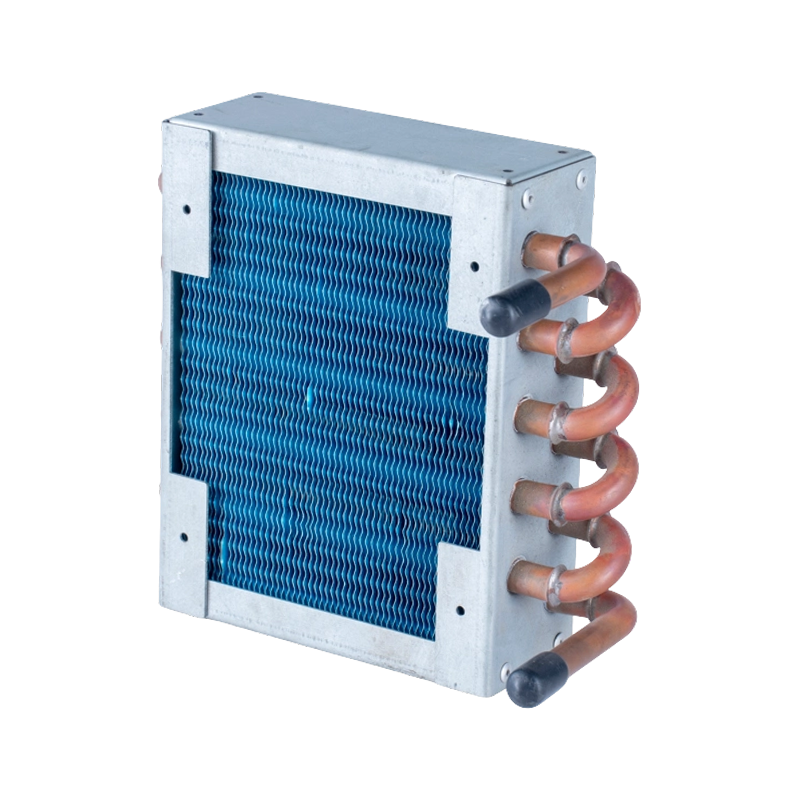 Compact All-Copper Condenser for Space-Limited InstallationsThis compact condenser with hydrophilic corrugated fins and galvanized steel housing is ideal for modular or rooftop chiller layouts. Its efficient heat rejection helps manage condenser sizing and performance in tight spaces.View Product →
Copper versus Aluminium in Chiller Heat Exchangers
Material choice is the most visible difference between heat exchanger designs, and it has direct consequences for cost, weight and corrosion behaviour. Copper has been the traditional default because of its high thermal conductivity and ease of brazing. Aluminium is lighter, cheaper and, in many applications, more than adequate when the tube and fin design are matched to the operating conditions.
For chiller designers, the trade-off is not simply thermal conductivity. A copper tube may conduct heat slightly better, but the overall coil performance depends on fin efficiency, tube wall thickness and the contact between tube and fin. Aluminium tubes can be drawn to thin walls, and all-aluminium coils avoid the galvanic potential that exists between copper tubes and aluminium fins.
| Property | Copper tubes | Aluminium tubes |
|---|---|---|
| Thermal conductivity | Higher per unit area | Lower, but compensated by thinner walls and fin design |
| Material cost | Higher and more volatile | Reduced by more than 30% in many production designs |
| Weight | Heavier, more structural support needed | Lighter, easier for rooftop and packaged units |
| Corrosion risk | Good with proper water treatment | Dependent on alloy and coating selection |
| Recyclability | Well established | Well established |
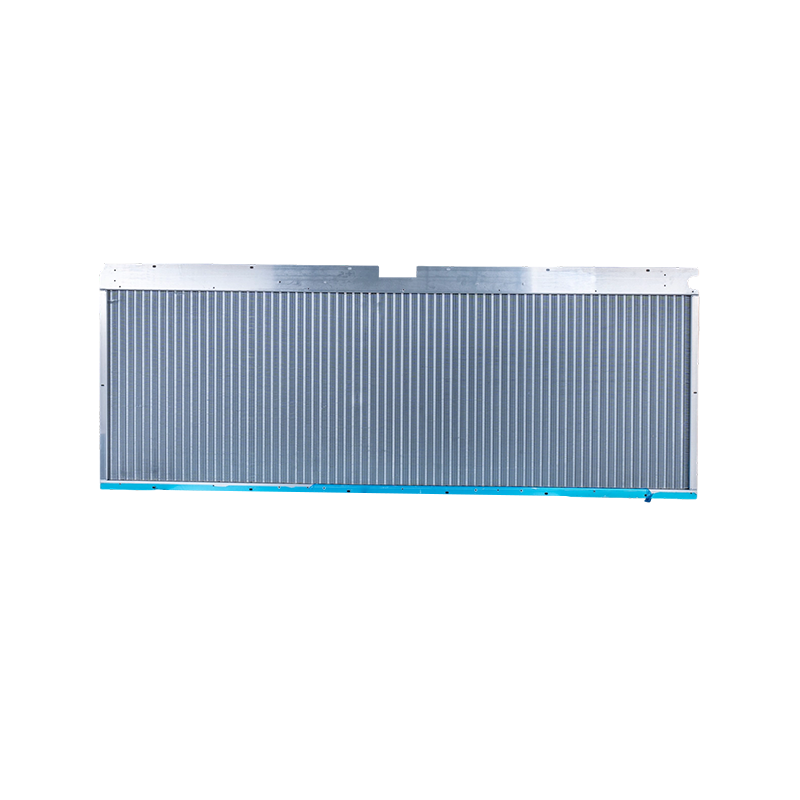
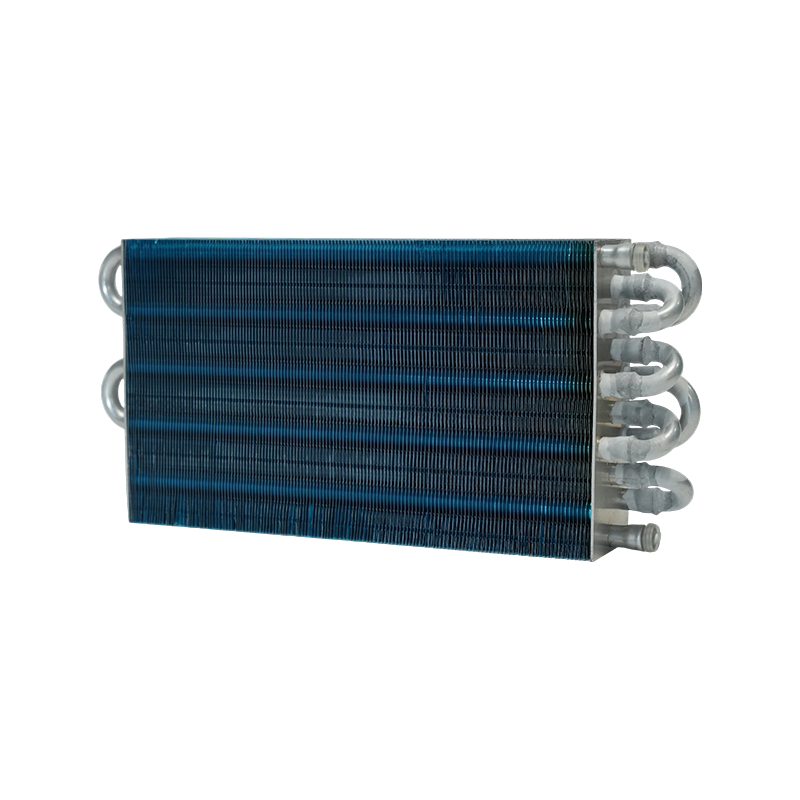
Aluminium tube technology has matured to the point that it can be used in condenser and evaporator coils without compromising reliability, provided the design is validated for pressure cycling and salt exposure. In our own production, aluminium tube two-phase products have passed 500-hour salt spray testing and 50,000 pressure cycling tests, which are practical benchmarks for chiller-grade quality. A broader look at how these choices affect maintenance and efficiency can be found in our HVAC heat exchanger guide.
Sizing and Customisation for Chiller Applications
A standard catalogue coil rarely delivers the best chiller design. Real projects involve site-specific conditions: a low-temperature process loop, a condenser with limited ambient airflow, or a physical envelope that cannot accommodate a traditional shell-and-tube layout. That is where custom heat exchanger design earns its keep.
The design process should follow a logical sequence:
- Define the refrigerant, operating temperatures, flow rates and pressure drop limits.
- Select the heat exchanger type: plate, fin-tube, tube-on-tube or brazed construction.
- Optimise the circuiting pattern to match the refrigerant path with the water or air flow.
- Review the mechanical design for vibration, thermal expansion and refrigerant compatibility.
- Prototype and test the coil before committing to production tooling.
An OEM heat exchanger factory can support this process by producing samples, adjusting fin spacing, changing tube diameter and recommending alloys that suit the specific refrigerant and operating environment. The goal is not to overspecify the coil, but to remove unnecessary cost while keeping the required approach temperature.
Partnering with an OEM Heat Exchanger Manufacturer
Most chiller manufacturers do not want to design and build their own evaporators and condensers from scratch. They want a partner who understands refrigeration performance, can produce consistent components at scale, and is willing to align the coil design with the chiller’s performance map. That is the role of a custom heat exchanger supplier.
When evaluating a supplier for chiller-related exchangers, look beyond the catalogue price. Consider whether the factory can provide a detailed selection report, a prototype schedule, and batch production consistency. A supplier with experience in copper-to-aluminium replacement technology can often reduce material cost while maintaining the duty, which directly improves the chiller maker’s margin. The aluminium tube two-phase product manufacturing approach used by our factory, backed by 12 years of heat exchanger experience, is one example of how this works in practice.