gracezhang@yijiecool.com |
  English
 Español
 عربى
عربى


Condensers for Refrigeration: Types, Sizing, Selection, and Real-World Checks
Content
- 1 What a condenser actually has to accomplish
- 2 Matching condenser construction to the refrigeration duty
- 3 Specification numbers that decide real-world performance
- 4 Aluminum tube versus copper tube
- 5 Compact and space-constrained installations
- 6 Small-capacity refrigeration: ice makers, water dispensers and display cases
- 7 Quality checks and sourcing questions before you commit
A frozen food distributor replaced a failed condenser on a 5 kW walk-in freezer with a unit that looked identical. Two weeks later, on a 35 °C afternoon, discharge pressure sat roughly 3 bar above the original. Nothing was defective. The replacement simply rejected less heat for every degree of temperature difference across the coil, and that gap, capacity measured at a real ambient rather than a catalogue ambient, is where most refrigeration condenser problems begin.
The fix is not complicated. Size the coil on total heat rejection at the highest ambient the site will realistically see, choose the tube-and-fin construction according to refrigerant, corrosion exposure and cleaning access, then confirm someone can actually reach the coil with a brush. Everything else follows from those three decisions.
What a condenser actually has to accomplish
A condenser does three jobs in sequence, and a coil that does any one of them badly drags down the whole circuit. It desuperheats the hot gas leaving the compressor, condenses that gas into liquid at a pressure set by ambient air and airflow, then subcools the liquid slightly so flash gas does not appear before the expansion device.
The load it carries is always larger than the evaporator rating. Total heat rejection equals evaporator duty plus the electrical energy the compressor puts into the refrigerant, typically 1.2 to 1.3 times the evaporating load at medium temperature and higher where compression ratios climb in freezer work. Design capacity should always be quoted at a stated ambient and a stated temperature difference, often 10 to 15 K between condensing temperature and entering air for air-cooled units.
Undersize the coil and condensing temperature rises: the compressor works against a higher pressure ratio, mass flow falls, capacity drops and discharge temperature climbs. The compressor usually fails first, which is why condenser problems so often get blamed on the wrong component. Oversizing is not free either, since it brings extra refrigerant charge, a bigger footprint and more fan energy.
Matching condenser construction to the refrigeration duty
Five constructions cover the great majority of refrigeration duty. They are not interchangeable, and the wrong pick usually shows up as a service problem long before it shows up as a capacity problem.
| Construction | Typical refrigeration use | Heat rejection per face area | Service considerations |
|---|---|---|---|
| Bare tube (prime surface) | Reach-in cabinets, small condensing units, static airflow | Low | Tolerant of dust and easy to clean; bulky for the capacity it delivers |
| Plate fin tube | Remote air-cooled condensers, condensing units, cold room systems | High | The default choice; clean on schedule, with 2 to 4 mm fin spacing for clean air and wider spacing for dusty sites |
| Spine fin | Condensing units in coastal, dirty or corrosive locations | Moderate | Wrapped fin resists impact where plate fins bend; harder to comb clean |
| Microchannel (parallel flow) | Appliance and transport refrigeration, compact OEM packages | Very high | Small envelope and low charge; sensitive to debris and hard to clean, so it suits clean airstreams |
| Shell-and-tube or coaxial | Water-cooled systems, chillers, heat pumps, marine duty | Not face-area dependent | Needs water treatment; scaling rather than dust is the failure mode |
Cold room and frozen display duty usually lands in the plate fin and bare tube families, because those coils must keep working after years of dust, cardboard fibre and the occasional pressure wash.
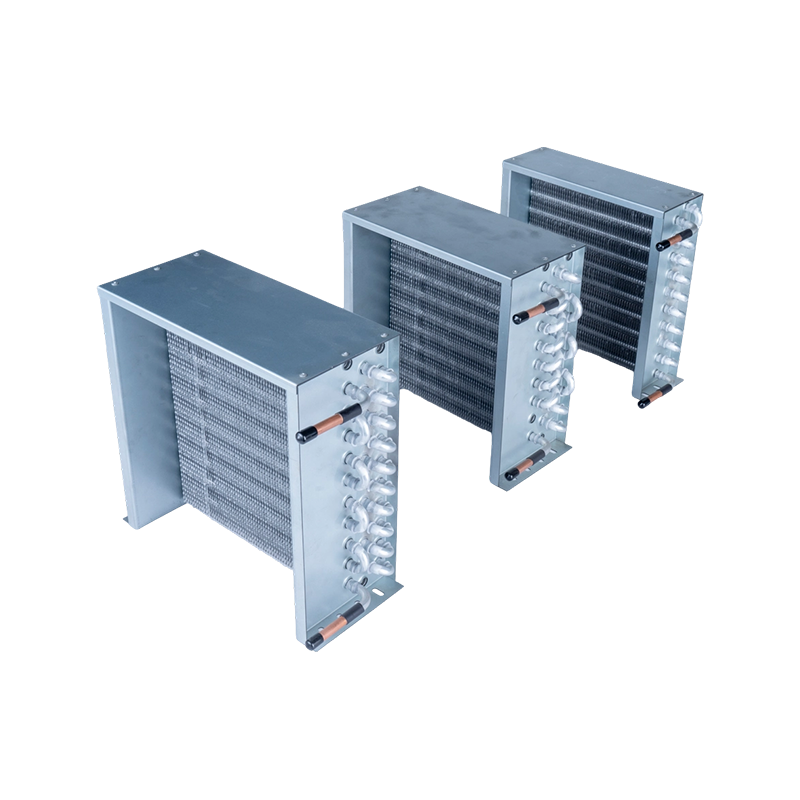 Freezer Condenser for Household and Commercial RefrigerationFreezer condenser with compact all-aluminum core and copper-aluminum welded piping, suited to household and commercial refrigeration where reliability and space savings matter.View Product →
Specification numbers that decide real-world performance
A condenser quotation is only useful when it states its conditions. Two coils with identical face dimensions can differ by 20 percent in capacity once fin density, tube diameter, circuiting and refrigerant are accounted for. Ask for these values on every data sheet.
- Refrigerant and the design condensing temperature
- Total heat rejection in kW at the stated ambient, not the evaporator rating
- Entering air temperature and the temperature difference the rating assumes
- Airflow in cubic metres per hour or cfm, with the static pressure at which it was measured
- Refrigerant-side pressure drop across the coil
- Subcooling delivered at design conditions
- Connection sizes, circuit count and internal volume for charge calculations
- Tube and fin material, any coating, and the corrosion test method named
Airflow quoted without a static pressure is a marketing number: a coil rated at free delivery loses much of that airflow once it sits behind a guard or inside a tight cabinet. Pressure drop matters in the other direction, since every bar of drop forces the compressor to run at a slightly higher ratio and that loss is paid for continuously.
Aluminum tube versus copper tube
Copper tube with aluminum fins has been the default for decades because it brazes easily, tolerates field repair and conducts heat extremely well. Aluminum tube coils have moved into the mainstream for different reasons: cost and weight. Manufacturers working with the technology report material cost reductions above 30 percent when copper tube is replaced by aluminum tube, along with a noticeably lighter coil.
The trade-offs deserve more attention than the headline. Aluminum conducts heat at roughly two-thirds the rate of copper, so tube walls, fin geometry and circuiting have to be redesigned to recover the difference. Joining needs controlled brazing or mechanical expansion rather than casual torch work, and placing both metals in one circuit invites galvanic corrosion unless a bimetallic transition joint isolates them.
Where aluminum earns its place is corrosion exposure. Published figures for aluminum tube two-phase coils cite a 500-hour salt spray test and 50,000 pressure cycles, with corrosion resistance and burst strength described as exceeding the applicable standard. Treat those as claims until the test conditions are on the table: salt concentration, chamber temperature, whether samples were scribed, and the pressure range of the cycle test all change what the number means. A general HVAC heat exchanger guide is a useful sanity check before locking in a material specification.
Compact and space-constrained installations
Cabinet coolers, under-counter units, transport refrigeration and vending equipment force a different set of compromises: a small coil, a small fan and a short air path. Compact condensers here are judged on capacity per unit of volume rather than capacity per square metre of face area.
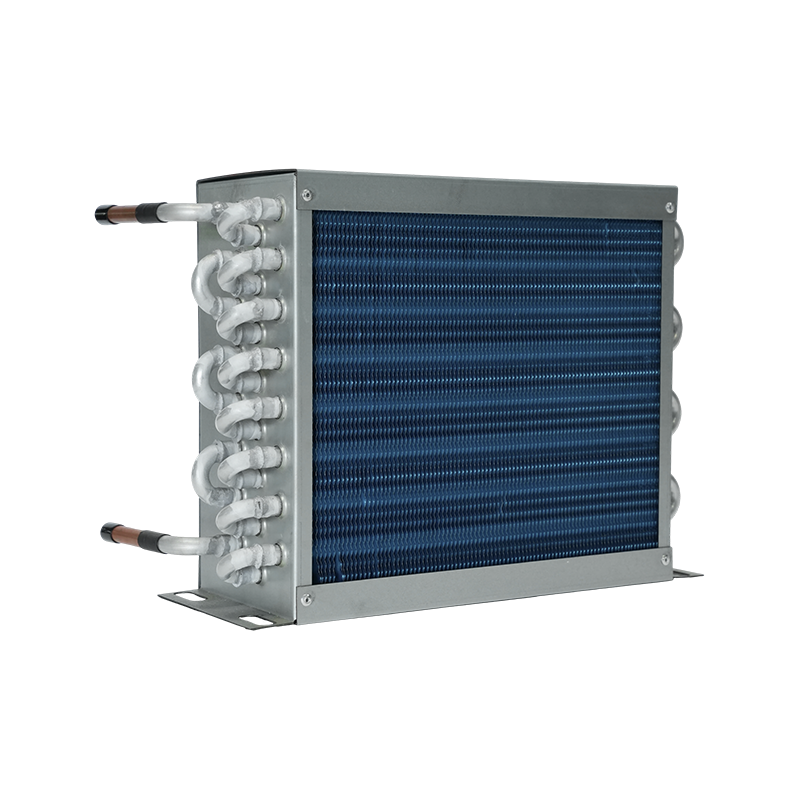 Compact Copper Condenser for Space-Saving RefrigerationCompact copper condenser for cabinet coolers, under-counter units, transport refrigeration and vending, offering hydrophilic corrugated fins and a space-saving all-copper core.View Product →
Three rules keep compact installations out of trouble. Leave at least one fan diameter of clear space in front of the coil face. Avoid discharging into a corner or into a neighbouring unit's intake, because recirculation can raise entering air by 5 K or more and quietly erase the capacity margin. And choose a coil that slides out or brushes through, since a compact coil with no cleaning access will lose capacity within a couple of seasons in a workshop or kitchen.
Small-capacity refrigeration: ice makers, water dispensers and display cases
Ice makers are among the hardest small-capacity duties. The coil sits in a warm kitchen surrounded by grease, flour dust and humidity, and it must reject heat quickly during a harvest cycle. Fin spacing, coating and cleanability decide the working life of a precision ice maker condenser far more than a few percent of rated capacity.
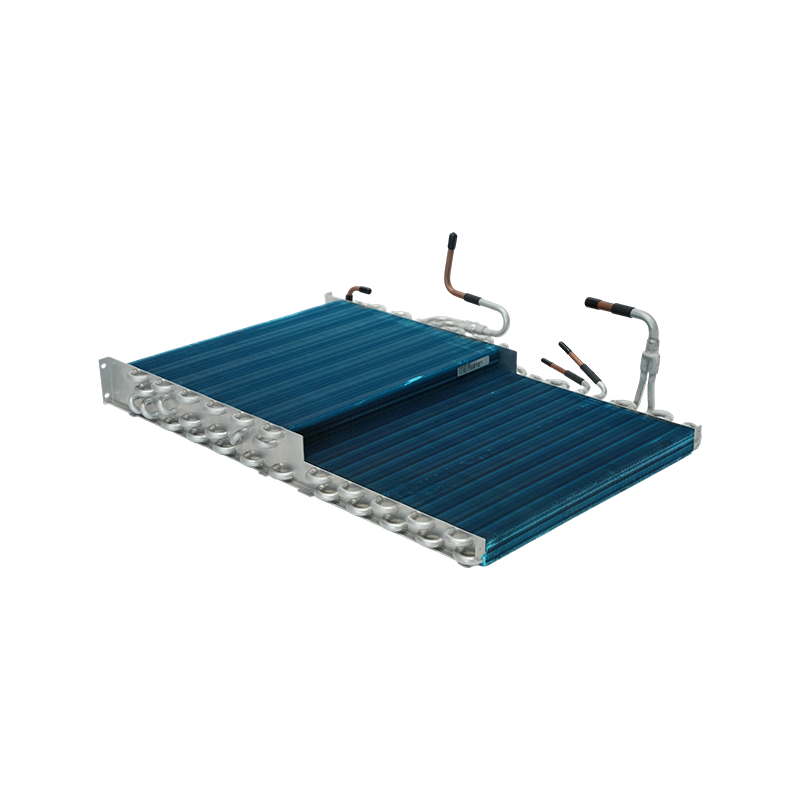
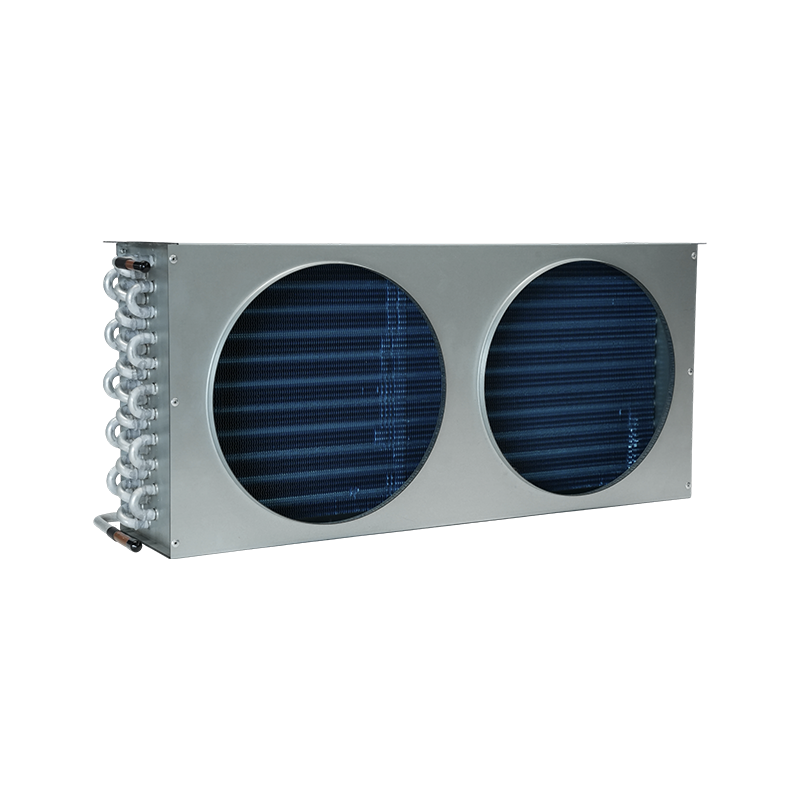 Precision Ice Maker Condenser for Compact Cooling SystemsPrecision ice maker condenser for water coolers and beverage dispensing, with hydrophilic aluminum foil fins and copper-aluminum welded piping in a space-saving build.View Product →
Water dispensers, bottle coolers and small display cases are gentler, but the principle holds: specify against the ambient inside the machine, not the ambient in the room. Cabinet air can run 8 to 10 K warmer than the surrounding space, and a coil selected on room temperature will be permanently short of capacity.
Quality checks and sourcing questions before you commit
Most condenser failures trace back to something that could have been checked before the first shipment. When comparing suppliers, ask:
- Which leak test runs on every unit, helium mass spectrometry, nitrogen pressure decay, or both?
- What pressure range and cycle count were used in qualification testing?
- Which corrosion test was performed, and does the report name the chamber conditions?
- What dimensional tolerance is held on connection positions and mounting holes?
- Was capacity verified on a calorimeter or simply calculated?
- What is the standard lead time, and how does it change for a custom circuit?
- Which documents ship with the order, such as test reports and material certificates?
Answer those questions and the specification conversation becomes short and factual. It also helps to see the full range before narrowing the list, so the downloadable product catalogue (PDF) is a reasonable place to start comparing coil families against your duty.
Condensers for refrigeration are bought once and lived with for a decade or more, which is why the sizing conversation matters more than the purchase price. Get heat rejection right at the real ambient, match construction to the dirt and the refrigerant, and choose a tube material whose test evidence you have actually read. Then confirm that someone can reach the coil with a brush. Those four checks prevent most of the field failures that get blamed on the compressor.